Saturday, August 6, 2011

Thank climate change for the rise of humans


Some claim climate change will destroy our species; now it seems it also helped forge it. The rapid fluctuations in temperature that characterised the global climate between 2 and 3 million years ago coincided with a golden age in human evolution.

The fossil record shows that eight distinct species emerged from one hominin species, Australopithecus africanus, and alive 2.7 million years ago. The first members of our genus appeared between 2.4 and 2.5 million years ago, while Homo erectus, the first hominin to leave Africa, had evolved by 1.8 million years ago.

To work out whether climate had a hand in the speciation spurt, Matt Grove of the University of Liverpool in the UK turned to a global temperature data set compiled by Lorraine Lisiecki at the University of California, Santa Barbara. Lisiecki analysed oxygen isotopes in the shells of fossilised marine organisms called foraminifera. During glacial periods, the forams' shells contain more of the heavier of two oxygen isotopes, as the lighter one is preferentially accumulated in snow and ice rather than the ocean.

Grove found that the mean temperature changed suddenly on three occasions during the last 5 million years. Each change was equivalent to the difference between glacial and interglacial temperatures - but none of these episodes coincided with the hominin "golden age". What marked out this period was a greater range of recorded temperatures, suggesting it was a time of rapid but short-lived fluctuations in climate. Grove says such conditions would have favoured the evolution of adaptability that is a hallmark of the genus Homo (Journal of Archaeological Science, DOI: 10.1016/j.jas.2011.07.002).

Grove says the classic survival traits of H. erectus, forged during this period of change, include teeth suited for generalised diets and a large brain - both of which should have been advantageous at a time of swift climate change.

Friday, August 5, 2011

La Ninas distant effects in East Africa: Droughts and floods are remote-controlled climate effects


For 20 000 years, climate variability in East Africa has been following a pattern that is evidently a remote effect of the ENSO phenomenon (El Niño Southern Oscillation) known as El Niño/La Niña. During the cold phase of La Niña, there is marginal rainfall and stronger winds in East Africa, while the El Niño warm phase leads to weak wind conditions with frequent rain.

Moreover, during the coldest period of the last ice age about 18 000 to 21 000 years ago, East Africa’s climate was relatively stable and dry. This result was published by an international group of researchers from Potsdam, Switzerland, the United States, the Netherlands and Belgium in the latest issue of the journal “Science” (Vol. 333, No.6043, 05.08.2011).

ENSO with its warm phase (El Niño) and its cold phase (La Niña) is actually known as a climate phenomenon in the Pacific with global tele-connections. Using the example of climate variability in East Africa, the study shows the long-term impact of this phenomenon in this sensitive region. The sediments in Lake Challa in southeastern Kenya, at the foot of Mount Kilimanjaro, serve as a climate archive.

Sample cores that were drilled here show a pattern of stripes, so called annual laminae. Each individual layer holds information about the climate.
“The thickness of these layers varies according to the climate, from 0.08 to 7 millimeters,” explains Christian Wolff (University of Potsdam and GFZ German Research Centre for Geosciences).
“A comparison of temperature measurements in the tropical Pacific over the last 150 years shows a strong correlation between ENSO cycles and the rhythms of droughts and floods in East Africa.”
That is to say, two climate patterns are superimposed here. The basic rhythm is provided by the annual rainy seasons, which are linked to the so-called Intertropical Convergence Zone (ITCZ). This refers to the band of clouds near the equator, which is formed by sunlight and excessive evaporation. With the sun high in June on the northern hemisphere and in December in the southern hemisphere, this band of clouds and the rain associated with it moves north- or southwards, respectively. This seasonal event is apparently superimposed by the ENSO phenomenon.

The length of the drill core allowed the tracking of climate variations to the last ice age. Bio-geochemical proxy data and careful seismological exploration of the sediment layers brought together a very good agreement with the thicknesses of individual layers. It was found that even in the last glacial, when the world was about 5 degrees colder globally and thus the energy budget of the tropics system was smaller due to lower temperature, the ENSO phenomenon was seen as a superimposed pattern, albeit weaker.

In comparison, the last 3000 years were warmer and more volatile, with intensive dry and drought periods, as this year, and massive rainy periods, which frequently lead to flooding. Climate models show that this trend towards an increase in extreme dry and wet phases continues on in a warming world.

The study was funded by the DFG German Research Foundation, the ESF European Science Foundation and the U.S. National Science Foundation NSF.
Christian Wolff et al.: „Reduced Inter-annual Rainfall Variability in East Africa During the Last Ice Age”, Science, Vol. 333, No.6043, 05.08.2011

Breaking: IPCC Climate Scientist's peer reviewed paper invalidates IPCC 2007 report


If Rajendra Pachauri, Chair of the Intergovernmental Panel on Climate Change (IPCC) thought his troubles are over, think again.  Now one of his reviewers in a peer reviewed paper produced results that invalidate the main conclusions of the IPCC 2007 report called the AR4.

Previous research showing humans are responsible for emissions of CO2 is wrong. Increasing CO2 is not ‘driving the climate bus’ but is very much in the back seat to temperature. Natural processes alter isotopic ratios similar to expected from burning fossil fuels.

Till climate hysteria broke out, climate science always attributed increase in CO2 as only an outcome of temperature rise with a time lag. Even Al Gore inadvertently presented in his movie an An Inconvenient Truth a graph showing 800 year lead/lag issue related to the paleo temperature and CO2 graphs. This fact what climate sceptics always claimed was drowned by the roar of climate alarmism. Now one of their own, an IPCC reviewer, Professor Murray Salby, Chair of Climate at Macquarie University, Australia has turned "consensus science" on its head.

The popular climate skeptic blog Jo Nova comments:
"Over the last two years he has been looking at C12 and C13 ratios and CO2 levels around the world, and has come to the conclusion that man-made emissions have only a small effect on global CO2 levels. It’s not just that man-made emissions don’t control the climate, they don’t even control global CO2 levels.
Salby has worked at leading research institutions, including the US National Center for Atmospheric Research, Princeton University, and the University of Colorado. He is also been a visiting professorships at Paris, Stockholm, Jerusalem, and Kyoto, and he’s spent time at the Bureau of Meteorology in Australia. He has a strong list of publications here. And he is the author of this paper - Fundamentals of Atmospheric Physics, and Physics of the Atmosphere and Climate, due out in 2011."


Thursday, August 4, 2011

East African Famine: Yet Another example why IPCC model is off the mark


As one climate skeptic blog noted:
"The count of failed IPCC climate model predictions being wrong is likely unprecedented in the annals of science." 
The East African famine is just one of the several confirmations of such a conclusion. The IPCC models actually predicted more rains in East Africa due to global warming:  
"More people in eastern and western Africa will be likely to experience a reduction rather than an increase in water stress (Arnell, 2006a)."
The real significance of IPCC's model predictions going awry is that this may not be an one-off famine. The Pacific Decadal Oscillation (PDO) has turned negative and whenever it does, historical data indicates that La Ninas tend to be more frequent and stronger than El Ninos.  This in turn implies that East Africa should experience more frequent failure of rainfall and consequently drought and famine for the next 20-30 years. This is the full import of the IPCC's model failure.

Humanitarian agencies and NGOs like Oxfam, Christian Aid; CARE Save the Children etc have been dutifully implementing "climate adaptation" programmes based on IPCC models in East African countries. The results are now obvious to all. Their so called climate adaptation programmes contributed to the spectre of mass starvation in East Africa. After accentuating the problem, these agencies have now launched famine appeals for funds! 

 
For India, the IPCC projected excess precipitation to the extent of a whopping 20%. However, Indian researchers (Read here) confirmed another climate model failure in regards to predicted precipitation trends across their entire country. Analyzing data from the 1901 to 2000, the researchers found that whatever global warming has taken place it has not caused an increase in mean annual rainfall.

"In light of global warming projections made by models used by the Intergovernmental Panel on Climate Change (IPCC), the authors write that several scientists have suggested that mean temperature patterns in the tropics and subtropics will change in ways that will lead to noteworthy changes in rainfall patterns.

...Based on precipitation data they obtained from 1384 rain-gauge stations maintained by the India Meteorological Department...The two researchers state that for all of India, as well as for each of its four sub-regions, there was substantial inter-decadal variability of annual rainfall that could be "attributed to the inter-decadal variability of eastern equatorial Pacific SST (Niño 3) or Indian Ocean Dipole Mode, but they say that "no significant trend is discernible during the last ten decades..."

[Manish K. Joshi and A. C. Pandey 2011: Journal of Geophysical Research]


Breath More Safely Now: Indian Nuclear plants can withstand disasters


NEW DELHI: A nuclear safety review has concluded that Indian nuclear plants will be able to withstand "extreme natural events" like tsunamis, cyclones, floods and dam breaks.

The government informed Parliament that after the Fukushima disaster in Japan, Nuclear Power Corporation of India Limited (NPCIL) had set up six taskforces to review safety features in Indian nuclear plants.

"These taskforces have revisited the safety of all nuclear power plants and found that Indian nuclear power reactors have sufficient margins and features in the design to withstand high intensity earthquakes and tsunami," the government said.

The taskforces also made some recommendations. Among the recommendations were that reactors will shut down automatically on sensing seismic activity and additional sources of power will be set up, including hook-ups through external sources of power like diesel generators. To factor in a longer duration power cut, the batteries will be augmented.

The government is focusing more on keeping the power going in reactors. In Fukushima, loss of the on-site emergency power systems prevented the cooling of the fuel rods. This led to overheating, resulting in hydrogen production and explosion due to a hydrogen fire. These events led to release of radioactivity in Fukushima Daiichi.

Nuclear plants at Tarapur and Madras atomic power stations will be given additional shore protection measures. Emergency operating procedures are being reviewed and training of personnel increased, the government said.
"Safety is a moving target and its upgradation is an ongoing exercise. The features, systems and procedures are periodically reviewed in the context of operational feedback and continuously evolving safety standards," the government said.
However, India will not review its commitment to nuclear energy, the government clarified.


Wednesday, August 3, 2011

Is La Niña re-emerging after a brief break?


The 2010-2011 La Niña was one of the strongest in recorded history. Though the La Niña was officially pronounced dead in April this year, this blog however had been predicting a multi-year La Niña with a short  intervening period of ENSO neutral conditions during the boreal (northern hemisphere) summer. This was the basis of a pattern thrown up by the analysis of its historical data.

There are preliminary indications that the 2010-2011 La Niña will be no different and most likely will take on a multi-year character. The recent ENSO wrap up data of Bureau of Meteorology (BoM), Australia for instance shows the Southern Oscillation Index (SoI) in clear La Niña territory at +9.9 after a very brief period in neutral territory.
(Note: Sustained positive values of the SOI above +8 may indicate a La Niña event).
Similarly, the Niño 3.4 value have turned negative at - 0.2 C, seem inching back to La Niña territory.
(Note: Sustained value above - 0.5 C may indicate a La Niña event).
If the La Niña re-emerges by September end in time for Northern Hemisphere, winter the bad news is that we can expect a surge in disasters. (Read here). The good news is the subsequent phases of a La Niña event is usually relatively less strong than the first phase - so the scale and frequency of disaster as seen last year should be considerably less. 


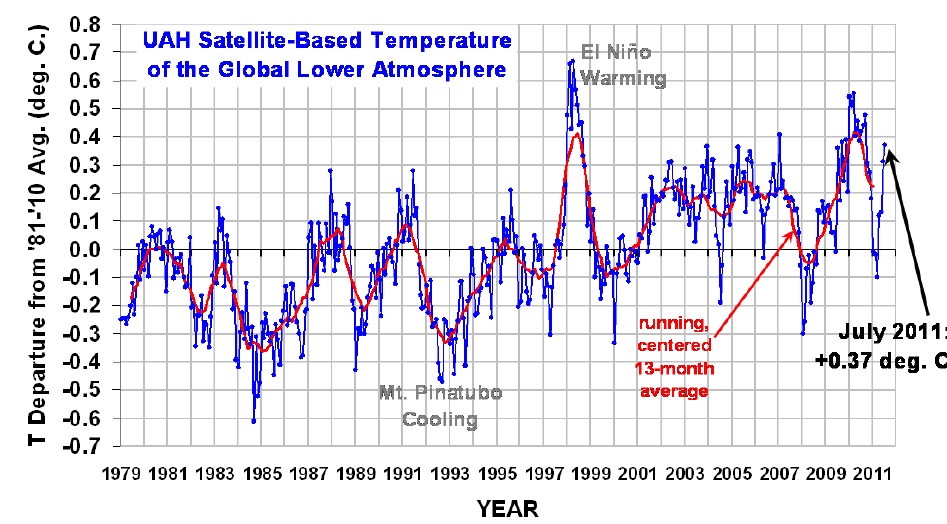
Global temperature anomalies as seen in the above graph have slightly increased to + 0.375 C for month ending July 2011. This should be the peak for this year and henceforth, global temperatures can be expected to start plunging again. 

Further, Stewart Franks, associate professor in environmental engineering at NSW's University of Newcastle, said his research suggested "enhanced" La Niñas for the next couple of decades at the very least.
"What we noticed is El Niño and La Niña events are actually not random, they tend to cluster, and they cluster on time frames between 10 to 40 years," he said.
Professor Franks, an Australian national representative to the International Association of Hydrological Sciences, said the last run of strong La Niñas occurred between the mid-1940s and mid-1970s, culminating in the 1974 floods. They were followed by about three decades dominated by El Niño dry climate patterns.
"We are seeing a return to the devastating impact of the enhanced La Niñas we saw in 1945 to 1975, so that indicates to my mind that it's entirely possible that were facing 20 to 30 years of repeated, frequent or enhanced La Niñas," he said.

India: Monsoon & La Nina

The "demise" of the La Nina is the primary reason why the IMD forecasted India's seasonal monsoon to  be 'below normal' in August and September. "Quantitatively, rainfall for the country as a whole during the period August to September is likely to be 90% of Long Period Average (LPA)," the India Meteorological Department (IMD) said  in its outlook for the second half of the monsoon session.

The annual rain season began on a good note with June receiving 111% falls, followed by a slump in July which witnessed 86% rains.
While the weather office sees 46% probability of below normal (86-94% of LPA) rainfall in the next two months, the probability of deficient rains (less than 85% of LPA) is 27%. The country has received 95% rainfall of the LPA in June-July. IMD said that the model error of 8% for August-September forecast would mean that some areas may get 98% rain while it may be 82% in other places.

The re-emergence of the La Nina if any could mean that the NE Monsoon in all probability could be above average and to that extent offset some of the deficiency of the SW Monsoon.

But there is still a good chance of normal rains during August-September. The Tokyo-based Regional Institute for Global Change (RIGC) have maintained their forecast for the return of La Nina conditions towards the autumn. The Climate Prediction Centre of the US National Weather Services too had come out with an outlook recently suggesting the return of La Nina later this year. 

In what is a good sign for the Indian monsoon, the RIGC has also said that the La Nina would be accompanied by a ‘weak positive Indian Ocean Dipole’ from August to November. 

The India Ocean Dipole (IOD) is a seesawing of ocean water temperatures in west and Indian Ocean, closely resembling the El Nino-La Nina phenomenon in the equatorial Pacific but with more direct and immediate impact on Indian monsoon.