Wednesday, July 25, 2012

Was Earth’s Optimal Climate Eocene, some 50 million years ago?


I have no doubt that global - that a trend of global warming exists. I am not sure that it is fair to say that it is a problem we must wrestle with.

To assume that it is a problem is to assume that the state of earth's climate today is the optimal climate, the best climate that we could have or ever have had and that we need to take steps to make sure that it doesn't change.

First of all, I don't think it's within the power of human beings to assure that the climate does not change, as millions of years of history have shown, 

and second of all, I guess I would ask which human beings - where and when - are to be accorded the privilege of deciding that this particular climate that we have right here today, right now is the best climate for all other human beings. I think that's a rather arrogant position for people to take."

Mike Griffin, NASA Administrator

Climate alarmists do not want our present climate to change. Implicit in this position is the assumption that our current climate is the most optimal. They want to retain the climate as it is now, treating the present as the best climate we ever had in earth’s history. However, Mike Griffin, NASA Administrator in a 2007 interview to US National Public Radio questioned the very rationale of such an assumption as seen in the above extracts from his interview. 

So what could be the most optimal climate the Earth has experienced so far?

Surprisingly, cutting across climate alarmist-sceptic divide, there exist almost a near unanimity of opinion among climatologists who treat the Eocene Epoch’s Climate, some 55-33 million years ago, as the period equivalent to Earth’s Golden Period or Paradise. Climate alarmists singularly blame human beings for supposedly triggering climate changes which they say hold catastrophic consequences for life on this planet. Homo sapiens i.e. human beings as a species had not yet evolved during the Eocene epoch. And yet average global temperatures were then 10 deg C higher than present with CO2 levels 4 times higher than current levels. Life productivity was in optimum, perhaps as never seen during Earth’s entire geological timeline.
Paul MacRae gives us a glimpse of the Ecocene in a paper entitled Back to the Future: Paradise Lost, or Paradise Regained? published in the popular climate sceptic blog WUWT 
Paul MacRae is an ex-journalist who has worked as an editor, editorial writer and columnist for several newspapers over the past 40 years, including The Toronto Star, Globe and Mail, Bangkok Post, and Victoria Times Colonist. In 2002 Paul switched to academia and now teaches English and professional writing at the University of Victoria and University Canada West, a new private university in Victoria, BC.

Paul maintains a website, False Alarm, where you will find excerpts from and notes of his book on climate change entitled False Alarm: Why Almost Everything We’ve Been Told About Global Warming is Misleading, Exaggerated, or Plain Wrong* (* Including the Claim that the Planet is Warming).

Back to the Future: Paradise Lost, or Paradise Regained?

Courtesy: WUWT


In June, a NASA climate study announced that the warm middle Miocene era, about 16 million years ago, had carbon dioxide levels of 400 to 600 parts per million.
The coasts of Antarctica were ice-free in summer, with summer temperatures 11° Celsius warmer than today. The study concluded that today’s CO2 level of 393 ppm was the highest, therefore, in millions of years, and could go to Miocene levels by the end of the century[1]. It was implied, although not directly stated, that readers should react with horror.
A UCLA team, writing in Science, had already pushed the Miocene button in 2009, claiming: 
“The last time carbon dioxide levels were apparently as high as they are today [15 million years ago, again the mid-Miocene]—and were sustained at those levels—global temperatures were 5 to 10 degrees Fahrenheit [2.7-5.5°C] higher than they are today, the sea level was approximately 75 to 120 feet higher than today, there was no permanent sea ice cap in the Arctic and very little ice on Antarctica and Greenland.”[2] 
Back to the Miocene! Scary!

James Hansen, the alarmist head of NASA’s Goddard Institute for Space Studies (GISS), regularly refers to past eras as a warning of the climate catastrophes that could occur today. For example, in 2011 Hansen warned:
“[An increase of] two degrees Celsius is guaranteed disaster…. It is equivalent to the early Pliocene epoch [between 5.5 and 2.5 million years ago] when the sea level was 25m (75 feet) higher.” [4]
Back to the early Pliocene! Horror!
And, in testimony to the U.S. government:
“The Earth was much warmer than today in the early Cenozoic [which began 65 million years ago]. In fact it was so warm that there were no ice sheets on the planet and sea level was about 75 meters (250 feet) higher.” [5]
Heavens! The planet could revert to the age of dinosaurs! (Hansen didn’t mention that sea levels today are 120 metres—almost 400 feet—higher than they were a mere 15,000 years ago, without creating a catastrophe.)

If we don’t curb our carbon-emitting ways, the alarmists warn, we face “increasingly radical temperature changes, a worldwide upsurge in violent weather events, widespread drought, flooding, wildfires, famine, species extinction, rising sea levels, mass migration, and epidemic disease that will leave no country untouched.” [7] The only catastrophe not mentioned here is “acidification” (i.e., a slight decrease in alkalinity) of the oceans.

If a warmer, more CO2-rich world would be hell in the future, it logically must have been hell in the past, too, when global temperatures were much warmer and carbon dioxide levels much higher. How could anything live, for example, in those “acidified” oceans of the Miocene? At least, this is what alarmist climate scientists like Hansen want the public to believe.

An Eocene ‘paradise’

Curiously, while alarmists warn about the horrors of returning to the climate of millions of years ago, paleoclimatologists tell a different story. They more often see our earlier planet as a “paradise,” even “paradise lost.”

In fact, “paradise lost” is the subtitle of a 1994 book on our planet 33 million years ago by veteran paleo-climatologist Donald A. Prothero—The Eocene-Oligocene Transition: Paradise Lost.
The Eocene (55-33 million years ago) began what is sometimes called the Golden Age of Mammals. This geological age was at least 10°C warmer than today, free of ice caps, and with CO2 levels, Prothero suggests, of up to 3,000 parts per million, which is almost eight times today’s level of about 400 ppm. Yet Prothero calls the Eocene a "lush, tropical world.”[8]
At the end of the still very warm Oligocene (33-23 mya), Prothero puts CO2 levels at 1,600 ppm, or four times today’s levels.[9] Prothero’s 1994 CO2 estimates may be a high, but no one—not even Hansen—denies that CO2 levels were several times higher than today’s in the Eocene and Oligocene and, indeed, right down to the Miocene (23-5 mya).

For Prothero, the boundary between the Eocene and Oligocene was “paradise lost” because it was then, about 33 million years ago, that the planet began its slide from a “lush, tropical world” into its current ice age conditions (see Figure 1), with glaciations every 85,000 years interspersed with brief, 15,000-year warm interglacials.
 
In fact, the planet is currently its coldest in almost 300 million years. Yet, for Hansen and others in the alarmist camp, our ice-age world is in danger of getting too hot—maybe even as hot as the Pliocene, or the Miocene, or the Oligocene, or even, heaven forbid, the Eocene.

Many other writers on paleoclimate also use the term “paradise” to describe climate in the distant past. For example, in a history of evolution for younger readers, science writer Sara Stein paints the Eocene of 50 million years ago as follows:
“The world that all the little brown furry things [mammals] inherited from the dinosaurs was paradise. [emphasis added] The climate was so mild that redwoods, unable now to live much further north than California’s pleasant coast, grew in Alaska, Greenland, Sweden, and Siberia. There was no ice in the Arctic. Palm trees grew as far north as 50 degrees latitude, roughly the boundary between the United States and Canada. Below that subtropical zone—that was similar to Florida’s landscape today—was a broad band of tropical rain forest.”[10]
Sounds grim, doesn’t it?

One of the most prominent climate alarmists, Tim Flannery, also uses the “p” word when he describes Eocene North America in his very readable The Eternal Frontier,on the geological and biological history of North America. Flannery writes:
When Earth is warm (in greenhouse mode)—as it was around 50 million years ago—North America is a verdant and productive land. [emphasis added] Almost all of its 24 million square kilometers, from Ellesmere Island in the north to Panama in the south, is covered in luxuriant vegetation.[11]
Flannery titled the section of the book that deals with the “verdant and productive” Eocene as: “In Which America Becomes a Tropical Paradise.” Yet this was a time, it should be remembered, when temperatures and CO2 levels were much higher than today’s. Unfortunately, trapped in his alarmism, Flannery doesn’t see the irony.

British paleontologist Richard Fortey describes the landscape of Australia 20-35 million years ago, during the Oligocene and Miocene, as being “as rich as Amazonia, green and moist, with trees and ferns in profusion.”[12] Today much of Australia, an area the size of the continental United States, is desert and bush and supports only 22 million people compared to 300 million in the U.S.

As recently as 125,000 years ago, the peak of the last interglacial, our planet was 3-5°C warmer than today at the poles according to the Intergovernmental Panel on Climate Change (IPCC) itself, with sea levels 4-6 metres (12-20 feet) higher than today’s interglacial so far.[13] Even Britain was semi-tropical, with hippopotami gamboling in the Thames, apparently untroubled by extreme weather events, extreme droughts, extreme flooding, etc.

A mere 7,000 years ago, during the Holocene Optimum period that was at least 1°C warmer than today, much of the Sahara Desert was green, as were many other regions that today are desert.[14] Why? Because warmer temperatures mean less polar ice, making more water available for precipitation, and therefore promoting a greener planet.

So, millions of years ago, during geological eras much warmer than ours, with much higher levels of carbon dioxide, the planet faced the same environmental hazards as today—volcanoes, earthquakes, tsunamis and the like. But it was not plagued by the extreme weather events, extreme droughts, extreme flooding, mass extinctions, or even the ocean “acidification” claimed by climate alarmists for the world of the future.

Sea level ‘disaster’?

On only one point have the alarmists got it right: during these warmer times of the geological past sea levels were higher, sometimes many metres higher—a point Hansen mentions again and again in his presentations.
For example, Hansen notes that while only two per cent of the Earth’s land surface is within 10 metres of sea level, this two per cent also has 10 per cent (more than 630 million) of the world’s population. Hansen says a five-metre (15 foot) rise would, without costly dikes or other measures, inundate many large cities, including New York, London, Shanghai and Tokyo. This sea level increase, he concludes, would be “disastrous.”[15] Hansen even seriously predicts five metres (15 feet) of sea-level rise by the end of the 21st century under a Business As Usual carbon scenario.[16]

However, most climate scientists—even alarmist scientists—know that Hansen’s predictions are hallucinations and accept that a sea level rise of this magnitude could only take place over centuries and millennia, just as sea levels today have taken 15,000 years to rise 120 metres (400 feet).

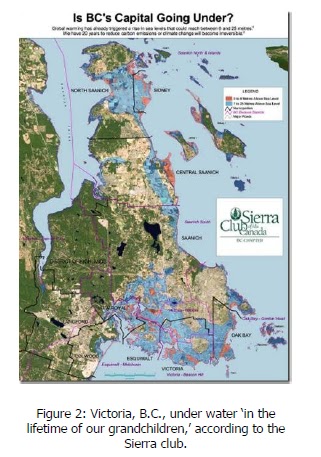
For example, in 2006 the Sierra Club released a map of Victoria, British Columbia, flooded by a sea-level rise of from six to 25 metres (see Figure 2). The Sierra Club predicted that if we did nothing about carbon emissions, flooding of this magnitude could occur “in the lifetime of our grandchildren,” that is, within the century.[17]
Even University of Victoria climatologist Andrew Weaver, an arch-alarmist, was moved to protest against this barrage of exaggeration and misinformation, writing to the Victoria Times Colonist letters page: 
 “The science suggests serious societal consequences of global warming in the short term, while the changes in sea level that the Sierra Club tout happen over thousands of years. [emphasis added] This clumsy story just makes it easy for the deniers to claim there is no problem.”[18]
The ultra-alarmist site de Smog Blog also joined the chorus against the Sierra Club’s absurd apocalyptism with a blog entitled “Sierra Club drowns in own climate catastrope” (the de Smog headline writer apparently could not spell “catastrophe”).

In other words, in the real world (as opposed to Hansen’s world), sea-level rise of any magnitude will take centuries and even millennia. The current rate of sea-level increase is just over 2 mm a year, or about 20 cm per century. At this rate—and at the moment the rate shows no signs of increasing—sea levels would take 2,500 years to reach Hansen’s five metres. Based on several interglacials over the past 600,000 years, which at their peak had sea levels several metres higher than today’s levels according to the IPCC, the seas would rise five metres or more even if human beings didn’t emit carbon.

Coping with sea-level rise

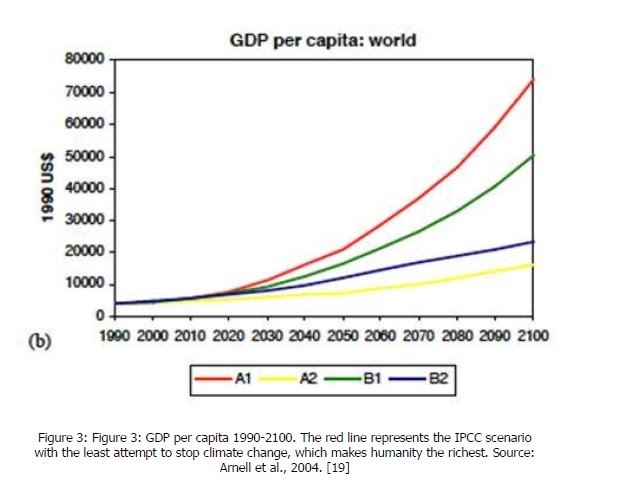
Can humanity cope with rising sea levels, whatever those levels may be? If climate alarmists don’t cripple our carbon-based economy, even the IPCC predicts that both developed and developing countries will have all the prosperity they need to cope with rising sea levels, be it seawalls, landfill, or relocations to desert and polar areas that, thanks to warmer temperatures and greater precipitation, are now fit for settlement.
Figure 3 shows GDP per capita for four of the IPCC’s climate scenarios, from Business As Usual (A1) to anti-carbon, between 1990 and 2100. In all four scenarios, humanity becomes better off, but humanity is best off in the red-line, A1 scenario, which is basically Business As Usual.
In the red BAU scenario, the world’s per capita income will rise from $5,000 a year in 1990 to $70,000 a year in 2100, based on 1990 dollars. In other words, if we do nothing at all to try to stop global warming, by 2100 even poor countries will have the resources they need to adapt to climate change, whether warmer or cooler.
And, again, a warmer, wetter planet would “green” many of the world’s desert regions, including the Sahara and Australia, just as warming did in ages past. Meanwhile, thousands of square miles of land currently under ice or Arctic scrub would be open to settlement.

A wetter, greener world

And this still doesn’t take into account the positive effect of higher levels of CO2 in fertilizing plants. Physicist and biologist Sherwood B. Idso, who has specialized in charting the relationship between CO2 and plants, notes:

A simple 330 to 660 ppm doubling of the air’s CO2 content will raise the productivity of all plants, in the mean, by about one-third. … As atmospheric CO2 concentrations more than double, plant water-use efficiencies more than double, with significant improvements occurring all the way out to CO2 concentrations of a thousand ppm or more.

Think of what such a biological transformation will mean to the world of the future. Grasslands will flourish where deserts now lie barren. Shrubs will grow where only grasses grew before. And forests will make a dramatic comeback to reclaim many areas presently sustaining only brush and scattered shrubs. [20]

Sound utopian? Even the IPCC acknowledges that doubled CO2 levels can produce increases of up to 33 per cent in plant growth, while also making plants more drought resistant.[21]

Millions of years ago our planet was much warmer and wetter than today, with much higher levels of CO2. Alarmists like Hansen say a return to those temperatures and CO2 levels would be catastrophic. Yet our planet in earlier geological ages is almost always described as a tropical paradise, not a blasted, carbon-choked hell. Sea levels were higher, but a prosperous humanity can cope with higher sea levels.

However, the huge Antarctic ice cap—the “deep freeze” in our planet’s basement—didn’t exist in the Eocene or Oligocene. So even if the catastrophic warming hypothesis is valid—that’s doubtful, but if—it’s unlikely our planet will go back to Eocene or Oligocene warmth.

But if, as alarmists warn, we return to the Pliocene, or even the Miocene, would that be paradise lost? Or paradise regained?

Sources 

[1] “Study finds ancient warming greened Antarctica.” NASA website, June 17, 2012.
[2] “Last Time Carbon Dioxide Levels Were This High: 15 Million Years Ago, Scientists Report,” Science Daily, Oct. 8, 2009.
[3] James Hansen, “G-8 Failure Reflects U.S. Failure on Climate Change.” Huffington Post, July 9, 2009.
[4] Hansen, Address to American Geophysical Union, December 2011.
[5] Hansen, “Statement of Witness James E. Hansen.” No date given.
[6] Hansen, Storms of My Grandchildren: The Truth About the Coming Climate Catastrophe and Our Last Chance to Save Humanity. New York: Bloomsbury, 2009, p. 265.
[7] Nuclear lobbyist John Ritch. Quoted in Tom Zoellner, “Nuclear power gets its swagger back.” Globe and Mail, March 14, 2009, p. F5.
[8] Donald R. Prothero, Eocene-Oligocene Transition: Paradise Lost. New York: Columbia Univ. Press, 1994, p. 35.
[9] Prothero, pp. 22, 238
[10] Sara Stein, The Evolution Book. New York: Workman Publishing, 1986, pp. 245-246.
[11] Tim Flannery, The Eternal Frontier: An Ecological History of North America and its Peoples. London: Vintage, 2002, p. 84.
[12] Richard Fortey, Life: A Natural History of the First Four Billion Years of Life on Earth. New York: Alfred A. Knopf, 1998, p. 270.
[13] IPCC 2007 Summary for Policymakers, p. 9.
[14] See Wikipedia “Holocene climatic optimum” and “Green Sahara” for details.
[15] Hansen, “Climate Catastrophe.” New Scientist, July 28, 2007.
[16] Hansen and Makiko Sato, “Paleoclimate Implications for Human-Made Climate Change,” 2011.
[17] “Rising ocean would flood much of Greater Victoria.” Victoria Times Colonist, Dec. 6, 2006.
[18] Andrew Weaver, “Scary story sets back understanding.” Letter, Times Colonist, Dec. 8, 2006.
[19] Nigel Arnell, et al., “Climate and socio-economic scenarios for global-scale climate change impacts assessments: Characterising the SRES storylines.” Global Environmental Change, 14 (2004), p. 9. See also Indur Goklany, The Improving State of the World. Washington, Cato Institute, 2007, pp. 303-309.
[20] Sherwood B. Idso, “Carbon dioxide and global change.” Rational Readings on Environmental Concerns, Jay H. Lehr, ed. New York: Van Nostrand Reinhold 1992, p. 422.
[21] IPCC 2001, Chapter 3, Section 3.2.2.4, p. 195. See also IPCC 2007, Working Group III, Chapter 3, Section 3.2.1.6, “Land use change and land use management.”


Tuesday, July 24, 2012

WWF boots out King Carlos of Spain for hunting


World Wildlife Fund for Nature (WWF) - it’s all about protecting wildlife, right? 

Wrong. It’s all about snuffing of life, whether human or animal. Here’s the snap shot of King Juan Carlos last year in Botswana and proudly displaying his trophy - an endangered African elephant shot dead at point blank range by him!
King Juan Carlos of Spain's secret passion for hunting has cost him his title as president of the country's branch of the World Wildlife Fund.
The monarch has held the position since 1968, but he has been ousted after news broke he made a secret trip to Botswana in April to hunt elephants.

Announcing its move today, WWF  said King Juan Carlos' expedition was incompatible with its goal of conserving endangered species. 

The organization added in a statement that 'although such hunting is legal and regulated" it had 'received many expressions of distress from its members and society in general.' 

It said members voted at a meeting Saturday in Madrid to 'to get rid of the honorary President' by a substantial majority of 226 votes to 13.


Lest you consider King Carlos an aberration, take a look at the snap above. The first and the longest serving President of the WWF, Prince Philip of Windsor House of the UK after a good hunting trip in India.  Here Prince Philip stands next to the tiger he shot. The WWF now tells us that the tiger is an endangered species in India and through striking alliance with news channels like NDTV had hyped their Save the Tiger campaign. They expect us to conserve tigers so that their biggies have adequate game to  satisfy their blood thirsty cravings..


And above the current President of WWF, Prince Charles in a hunting trip and below the future President of WWF, Prince Williams in a hunting trip with new wife!


Remember, the WWF-IUCN is the ring leader of the climate scam. They are also the primary authors of Climate Smart Agriculture (CSA) being implemented in India by international NGOs like Oxfam; ActionAid; ChristianAid; CARE; Greenpeace etc which aims to cull the Indian population by causing famine and starvation deaths through reducing agriculture yields in the country.
SIGN THE PETITION

The World Wildlife Fund (also known as the Worldwide Fund for Nature, or simply WWF) has been actively pressuring government agencies in the U.S., Europe, and Canada to increase the amount of testing that they require for pesticides and other chemicals.

The WWF was the driving force in pressuring the U..S.. Congress to legislate the screening of chemicals for "endocrine (hormone) disrupting" effects and has subsequently been heavily involved in establishing the framework for the Environmental Protection Agency's (EPA) massive chemical-testing program now under development. . As its Web site points out: "WWF invested substantial resources in the EPA's Endocrine Disruptor Screening and Testing Advisory Committee," which "agreed upon a set of tests to form the foundation for the screening and testing program.."

What the WWF neglects to mention, however, is that 10 of the 15 recommended screens and tests are animal-poisoning studies, some of which kill hundreds or thousands of animals at a time.. According to scientific estimates, the WWF-backed endocrine testing program will kill up to 1..2 million animals for every 1,000 chemicals tested, and with environmental organizations pressing for tens of thousands of chemicals to be retested under this program, the toll in animal suffering and death will be staggering.. The WWF is also pressuring government agencies in Europe to embark on a similar animal-testing program.

In addition to lobbying for more chemical testing, the WWF has teamed up with Procter & Gamble, S..C.. Johnson, and other chemical companies to create an institute to pursue "basic research" on endocrine disruptors.. On top of this, the WWF is now pushing the U..S.. Congress to pass a bill that would pour additional millions in public funds into endocrine research--much of which would likely be used to fund experiments on animals..

Unfortunately, the "endocrine disruptor" issue is not an isolated example.. The WWF has been a major force in pressuring the European Union to amend its Chemicals Policy to require companies to test and retest as many as 30,000 new and existing chemicals.. The British Institute for Environmental Health estimates that this process will kill upwards of 45 million animals if the standard battery of animal-poisoning tests is used..

The WWF's U..S.. and Canadian offices are also calling for more testing of pesticides, despite the fact that more than 9,000 animals are already killed for each pesticide product on the market.. The organization has called for certain pesticides to be tested for "developmental neurotoxicity" (DNT) using a test that kills upwards of 1,300 animals each time it is conducted.. This test has been heavily criticized by scientists, including the EPA's own Scientific Advisory Panel, which concluded that "the exposure of rat fetus/pups was not shown to be equivalent to human fetus/infant during equivalent stages of brain development" and that "the current form of the DNT guideline is not a sensitive indicator of toxicity to the offspring.." In other words, WWF is calling for thousands of animals to be killed in a test that scientists admit is not relevant to humans!

In its defense, the WWF says that "in the absence of effective, validated alternatives, WWF believes that limited animal testing is needed for the long-term protection of wildlife and people throughout the world.."
However, there is nothing "limited" about the massive amount of animal testing that the WWF is endorsing.. Dr.. Joshua Lederberg, Nobel Laureate in Medicine, pointed out in 1981: "It is simply not possible with all the animals in the world to go through chemicals in the blind way we have at the present time, and reach credible conclusions about the hazards to human health.."

Now more than 20 years later, millions of animals are still dying in agonizing chemical toxicity tests, and we are no closer to getting dangerous chemicals out of the environment. . In fact, despite killing hundreds of thousands of animals in painful chemical toxicity tests, the EPA has not banned a single toxic industrial chemical in more than a decade!...

The WWF Endorses the Killing of Wild Animals, Too!!!

The World Wildlife Fund (WWF) gives special meaning to the word "conservation. ." The organization, founded in 1961 by a group of wealthy trophy hunters, apparently believes that conserving animals means keeping them around long enough for well-heeled "sportsmen" to blast them out of the woods, oceans, skies, plains of Africa, and jungles of Asia.. Past WWF chapter presidents include C..R.. "Pink" Gutermuth, who also served as president of the National Rifle Association, and trophy hunter Francis L.. Kellogg, who is legendary for his massive kills.. In its early days, the WWF even used fur auctions to raise funds...

Since then, the WWF has learned that most people are appalled by hunting and trapping, so today, the organization veils its true stance under phrases like "sustainable development, " arguing that killing is acceptable under some circumstances. . When answering difficult questions about its policy on hunting, trapping, and whaling, the WWF is careful never to state outright that it approves of all these activities.. But don't be fooled, the WWF's intentions are all too clear and deadly!!

Sealing

According to the Web site of the WWF's Canadian office, "WWF is not an animal welfare organization. . We support the hunting and consumption of wild animals provided the harvesting does not threaten the long-term survival of wildlife populations. . WWF has never opposed a sustainable seal hunt in northern or eastern Canada.." However, despite the WWF's portrayal of the situation, the Canadian seal hunt is anything but a "subsistence" hunt--it is the largest slaughter of marine mammals in the world.. Quotas established by the Canadian government have soared to an all-time high: 350,000 seals per year for the next three years.. Not since the mid-1800s, when unrestricted slaughter saw a million seals per year killed, has so much blood been shed on the ice off Canada's East Coast...

Worse is that the Canadian government has stated in internal documents that having the WWF's support for any raise in seal quotas is important, and the WWF's position statement suggests that it had been working with the Canadian government before the quota was announced.. In other words, the WWF had the power to help avert the largest quota of harp seal pups in history but chose, instead, to let it happen without so much as a word of opposition!! !

Whaling!!!

While the WWF states that it opposes "commercial whaling," it does support the slaughter of whales by native tribes and under some other conditions.. When asked directly about its policy, WWF is vague, stating: "WWF's views on whether sustainable whaling should be permitted derive from its mission 'to conserve nature and ecological processes and to help build a future in which humans live in harmony with nature..'" In the past, WWF officials have clearly stated that "WWF International has the national WWF organizations behind it in the view that as soon as one can ensure a sustainable commercial harvest of the great whales under secure international control, then whaling will no longer be a WWF concern...."

Sport Hunting!!!

As one would expect of an organization founded by hunters, the WWF does not oppose the slaughter of animals with guns and other weapons for sport.. Rather than working to stop the killing, the WWF believes that hunting should be regulated, arguing that wealthy trophy hunters can bring income to poorer nations.. The WWF claims that it has no power to stop hunting, stating, "The decision to allow trophy hunting is a sovereign one made entirely by the governments concerned. -- We will continue to monitor governments' enforcement of important trade laws to ensure that trophy hunting is done within the legal standards of that area...."


Elephants!!!

The WWF believes that culling--another way of saying "killing"--elephants is acceptable, as is the trade in ivory, because the profits that it brings spur governments to keep elephants from going extinct.. In 2000, U..S.. News & World Report reported that WWF representatives traveled to Nairobi to ask the United Nations to lift the ban on the ivory trade in order to allow a "sustainable harvest of ivory for horns and hunting trophies..."


The WWF's bizarre view--that we must kill some animals now in order to save animals to kill later--has proved false time and again.. The trade in ivory has only encouraged rampant poaching, the senseless slaughter of elephants.. The WWF tries to duck the issue by falsely stating, "The decision to cull, or to select animals from the herd for removal or death, is indeed an agonizing choice, but it is one made entirely by the governments concerned and there is no international involvement in those decisions.."

Trapping!!!

As with hunting and whaling, the WWF refuses to condemn the massive killing of animals with steel-jaw leghold traps.. While calling itself a "preservationist" organization that "seek[s] to be the voice for those creatures who have no voice," the WWF stands back from the issue, stating that "the trade in furs, skins, and other products of animals that are not endangered isn't the focus of our campaign.."

But no matter how hard the WWF tries to "greenwash" its support of animal slaughter, its real message rings out loud and clear: Animals are ours to hunt, trap, kill, poison, and use as we see fit.. And although appeals to preserve genetic diversity, ecosystems, and the planet sound good on paper, they mean little if what the WWF is really advocating is more efficient killing fields...

Wolf Hunting!!!

Despite an ongoing international tourist boycott that was called in response to the wolf "control" program in Alaska, in which at least 100 wolves have been shot as of March 2004, the WWF is promoting several trips to Alaska throughout June, July, and August 2004 as part of "WWF Travel," an "ecotourism" program.. When asked why the WWF was sending its members to Alaska, effectively undermining efforts to save wolves in the state, the WWF travel desk representative stated that the WWF did not consider the matter of wolf-killing a priority..

WHAT YOU CAN DO?


Please write to the WWF and express your opposition to its involvement in the slaughter of millions of animals and their blood thirsty policies aiming to cull both human and animal life
Write to the Indian Trustee of Nitin Desai of WWF-India, Advisor to Prime Minister’s Committee on Climate Change here: nitin-desai@hotmail.com


Monday, July 23, 2012

UK: Energy Poverty to Increase. Households to pay £110 more as electricity bills'


British government plans to encourage nuclear and wind power 'will add £110 to electricity bills'

 
The planned shake-up of the electricity market could raise householders’ bills by more than £110 and put off investors, MPs have warned.

In a damning report, they say the Government’s planned revolution in how we produce energy – announced two months ago – will not benefit consumers and needs an ‘urgent rethink’.

The reforms are intended to guarantee high electricity prices for firms who invest in building nuclear power stations and wind farms to meet Britain’s green energy targets.

But the Energy and Climate Change Committee claims the decision to allow energy firms, rather than the Treasury, to guarantee these prices risks higher charges for bill-payers.

Committee chairman Tim Yeo, a former Tory environment minister, said the current plans would increase the power of the Big Six energy companies and ‘will not work for consumers in their present form.’

Ministers hope to put strict controls on coal-fired power stations and imported energy, while boosting renewable energy like wind, wave and solar power.

The Government’s climate advisers said last year that energy bills would rise by £190 by 2020 – with £110 of this down to renewable energy policies.

Barry Gardiner, a former Labour environment minister on the committee said: ‘We will lose a fifth of our generating capacity by 2020 and these reforms will not keep the lights on.

‘These plans do not reassure investors, and if there is pressure on supplies, it will drive up consumer bills. It’s vital the Government back a scheme which will incentivise investment and stop moving the goalposts.’

Last year David Cameron ordered the Big Six – whose profits per customer have soared – to do more to help customers onto cheaper tariffs.
Mr Yeo said: ‘Nobody wants to see a blank cheque written out for green energy, but the Government must provide investors with more certainty about exactly how much money will be available.’ 
Energy Secretary Ed Davey said: ‘The Energy Bill will enable us to make radical changes to the electricity market that deliver investment in secure, low carbon, affordable energy. We are determined to…develop a robust and effective Bill with the interests of both consumers and investors at the heart.’

UK: Windmills near house wipes 25% its market value


Wind farms DO hit house prices: Government agency finally admits that thousands can be wiped off value of homes
Courtesy: Daily Mail

The Valuation Office Agency has been forced to re-band homes near wind farms into lower categories


Wind farms can wipe tens of thousands of pounds off the value of homes, a government agency has admitted for the first time.

The Valuation Office Agency has been forced to re-band homes into lower council tax categories, confirming what most residents who live near the giant turbines already know: they are detrimental to property prices. The move will make it harder for the wind farm industry to dismiss public concerns over the impact of their turbines.

At least five homeowners have seen their properties officially downgraded by the VOA because of their proximity to windfarms. But only cases that go to appeal are made public by the agency, suggesting many more applications have been received for council tax discounts. 

In one case, a couple saw the value of their home near the Fullabrook wind farm site near Braunton, Devon, fall from £400,000 to £300,000 when they asked estate agents to value it. The home is 650 yards from three of the turbines and the couple feared that the noise and visual dominance of the turbines would not only de-value their home, but make it impossible to sell.

The VOA agreed to put the home from council tax F to band E, saving the couple £400 a year in council tax. Families living in the seaside Suffolk village of Kessingland have also applied to be put into a lower council tax band as many of their homes are near 400ft turbines.

When one resident, Sue Price, put her home up for sale last year for £460,000, she found a buyer. But they pulled out when local papers reported that the wind farms were about to be erected and estate agents told her to drop her price, she told the Sunday Times.
‘We went down to £360,000 and still could not sell so now we have taken it off the market,’ she said.
Waveney Council which covers the area has admitted that the constant swooshing noise does constitute a ‘statutory nuisance’, and is working on a technical solution with the wind farm operators, Triodos Renewables.

Recent council-tax rebandings by the Valulation Office are the first admission by an arms-length government body that house prices can be dented by wind farms. This is despite other studies pointing to their detrimental effects, including the Royal Institute of Chartered Surveyors who pointed out in a 2007 report that homes within one mile of wind farms would lose value.
Many residents in towns such as Llanllwni, in West Wales, have campaigned against wind farms being built near their homes
One in five prospective buyers rate peace and quiet as their number one priority when looking at a house, according to an Alliance and Leicester survey.Val Weedon, the honorary president of the UK Noise Association, said wind farms would have an impact on people’s quality of life and therefore house prices.
She said: ‘These re-valuations will set a precedent which the wind farm industry does not want. Wind farm noise is like road and airport noise, it has an impact on property prices.’‘Noise is also associated with headaches and nausea as it is a form of stress, so it can also have a detrimental effect on your health.’ 
It was revealed last week that every home in Britain will pay £88 to build a vast network of pylons in a £22billion project to link wind farms to the national grid.Bills will start to rise next year under the controversial plans revealed by industry regulator Ofgem.

An average of £11 will be added annually for eight years, making £88 in total on top of any other increases. The industry was recently dealt a blow by Chancellor George Osborne, who demanded huge cuts in government aid for wind farms. The Chancellor told the Treasury to draw up plans for a reduction of 25 per cent in subsidies for onshore wind farms.

A VOA spokesman said: ‘The Valuation Office Agency (VOA) is responsible for keeping council tax bands up to date in England and Wales. We do not record the number of occasions where a band challenge is made by a taxpayer due to the proximity of a wind turbine/farm.
‘If a taxpayer believes that the value of their home has been reduced by a substantial physical change to their locality, then they may be entitled to make a proposal to alter their band.'The proposal will be considered by the VOA, which may or may not result in a band change. If the taxpayer disagrees with the decision of the VOA, there is a right of appeal to an independent Valuation Tribunal.’


Sunday, July 22, 2012

Commonsense wisdom from African farmers


They know “sustainable development” really means sustained poverty and malnutrition

If you want to learn what farmers think (and need), talk to African farmers – not to bureaucrats, environmental activists or politicos at the Rio+20 United Nations summit in Rio de Janeiro. You’ll get very different, far more honest and thoughtful perspectives.

The recent (May 24) Food, Agriculture and Natural Resources Policy Analysis Network conference in Pretoria, South Africa brought together delegates from agricultural communities in many African countries. FANRPAN’s primary objective is to improve food security in Africa, by ensuring that small-scale farmers can become more productive. Their obvious enthusiasm and commonsense views were heartening.

FANRPAN chair Sindiso Ngwenya of Zambia gave an incisive presentation, pointing out that agriculture is the key to reducing poverty and ensuring food security in Africa. “We call upon the world to assist us,” he said, “not by treating us as beggars, but by treating us as equals.”

Ngwenya criticised many First World attempts to use climate change, biodiversity and sustainable development arguments to prevent African agriculture from advancing. “If you are using implements that were there before Christ, how much chance do you have?” he wanted to know.

And why would anyone think these UN-EU-US issues are important to African farmers and families who are trying to feed their families and neighbors, and improve their living standards by exporting their products?

Africa does not need foreign aid in the form of handouts, Ngwenya emphasized. African farmers need modern technology and reliable, affordable electricity. They need the world to buy African produce. Instead, far too often, European and other First World countries impose rules or block African exports, using a multitude of excuses that can no longer be tolerated.

FANRPAN has decided to go “Africa-wide,” Ngwenya announced. Africa is huge –larger than the United States, China, India and Europe combined. And yet 60% of its arable land is not used at all. On the arable land that is used in most African countries, crop yields are typically a quarter of the norm in South Africa. What’s needed, he said, are modern farming methods, seeds, fertilizers and equipment –at the level of every individual farmer.

Referring to the 2011 COP-17 world environment congress in Durban, South Africa, Ngwenya pointed out that the FANRPAN slogan is “No agriculture, no deal.” However, agriculture, and particularly the advancement of rural African agriculture, was not included in past COP objectives. Many delegates criticised this, saying it reflected the First World’s hope that Africa and African agriculture will remain primitive and underdeveloped, so that rich countries can praise Africans for being “sustainable” and protecting the planet.

Africans are being told by First World activists, politicians and pressure groups to “stay in tune with nature,” delegates noted – when this attitude really reflects a well-fed First World’s maneuver to retard African agricultural improvements.

When it came to the eternal climate change saga, FRANRPAN delegates emphasized “climate-smart agriculture” and noted that Africa has always experienced dramatic weather and climate variations. What’s needed now, they stresse, is sensible, fact-based science, to predict and adapt to local and regional climate cycles and variations.

Equally impressive was learning that a group of small-scale farmers from Burkino Faso had paid their own way to attend a meeting in Windhoek, Namibia, nearly 3,000 miles (4,500 kilometers) away, to present a petition calling for the development of evidence-based policies, to replace what to now have been emotional, harmful and oppressive policies, rules and treaties.

The delegates said they were tired of the First World telling them what to do, based on First World interests and perceptions. They understand all too well that calls for “sustainable development,” “biodiversity” and climate change “prevention” really mean demands for policies and practices that ensure sustained poverty and malnutrition.

FRANRPAN CEO Dr. Lindiwe Sibanda emphasized that the real work is done on the ground, at the level of individual countries – and “policy comes from people.” Individual countries must come to their own conclusions about what works for them, and countries must align their policies to ensure food security for their people, she said. Modern methods and technologies are also required, to enhance intra-Africa food trade and enable countries to export what they are good at producing.

Her enthusiasm was praised by a farmer who spoke from the floor, with a strong French accent. “There’s a lack of resources for small farmers to come here,” he said, even for important meetings like this, but he was glad he had spent the time and money to be there. Certainly, those that did attend exhibited enough excitement and enthusiasm for the millions who could not join them.

Chairman Ngwenya wrapped up the proceedings by criticising the apparently intentional side-stepping of agricultural issues during COP-17. The First World must stop impeding African farmers and end “the paralysis by analysis,” he said. Absolutely right.

There is far too much First World smoke and mirrors, telling Africans they are saving the planet – when the real intention is to stop them from acquiring modern technology and electricity that would allow them to surge to middle class or even rich country status.

This FANRPAN conference serves notice to the United Nations Environment Programme, Rio+20 Sustainable Development Summit, Europe, United States and other obstructionists that Africa has caught on to what they are doing – and is no longer willing to play their game.

That’s good news for every African, Asian, Latin American and other poor family that wants to eat better, live better and have the freedom to pursue their dreams.

Dr Kelvin Kemm is a nuclear physicist and business strategy consultant in Pretoria, South Africa. He is a member of the International Board of Advisors of the Committee For A Constructive Tomorrow (CFACT), based in Washington, DC (www.CFACT.org). Dr. Kemm received the prestigious Lifetime Achievers Award of the National Science and Technology Forum of South Africa.