Sunday, February 10, 2013

Documentary "Climate Crimes" - "Green" Policies That Are Killing Nature goes on air. "Greens" dive for cover


These days, much is spoken and written about the destruction of our planet as a result of climate change. In his evocative film “Climate Crimes”, the Austrian filmmaker Ulrich Eichelmann who was an active member of WWF for 17 years and worked in conservation for decades, now documents that it is rather the reverse: he shows how many ecosystems, species, habitats and the cultural heritage too are threatened – but, as he sums up, 
“not by climate change, but by climate protection and the things done in its name.”


Last week Austrian Broadcasting network ORF aired the controversial new film Climate Crimes in German.
Having seen the film in its entirety for the first time, I was truly horrified by the scale of the environmental destruction and mayhem brought on by the recent climate protection movement. It is truly madness at a whole new level and dimension. If you have the chance to see the documentary, then do so. You’ll be shaking your head throughout the film.

Indeed the level of destruction with respect to loss of eco-systems, biodiversity, erosion, etc. brought on by the “green economy” is far beyond anything man-made climate change was ever fantasized of causing by the year 2100. The current damage caused by the “green economy” is real, and it’s happening here and right now. Worse, it’s all taking place with the official green stamp of approval.

In the film, environmental economist Nico Paech says:
“Climate protection as it is practiced now is throwing the baby out with the bath water.”
The green economy, intended to rescue the climate from a man-made climate catastrophe in a computer, is in reality systematically accelerating the wide-scale destruction of the environment today by at least a factor of ten.

Many greens are having their eyes opened for the first time, and are now grudgingly admitting that something has gone terribly awry. Wiping out the Earth’s eco-system to rescue the climate is not what they had in mind.

Yet they still refuse to acknowledge that they’ve erred with the climate science, and that all the destruction was unnecessary. They still insist the computerized catastrophe is real, approaching fast, and that we need to act rapidly. The only thing they’re admitting is that the “green energy” sources of hydro-power and biofuel are no longer options. In their view the human race is now in a dilemma because so many sources of energy must never be used. There’s no painless way out.

After showing the Climate Crimes documentary, ORF held a discussion round discussion round. The theme of the discussion round was what needs to be done to get out of the (imagined) energy dilemma?

Four experts joined moderator Michael Hofer were Kurt Remele (ethics and theology expert), Angela Köppl (economics expert in the field of environmental economics, energy and climate protection and Angela Kallhoff (philosophy). The other was co-author of Die kalte Sonne, geologist Sebastian Lüning. Clearly the discussion was not to focus on climate science. For moderator Hofer and the 3 other guests, the science is settled in their view, and there was no need to discuss it. Thus the discussion focused on environmental ethics and man’s responsibilities.

Most of the discussion round was filled with the usual “the end is near” crap. The three greenie guests kept reminding the audience of our generational, environmental and social responsibilities. They told us of the “massive impacts” humans were having, and about all the “dramatic destruction” humans were causing.

We were reminded it would be necessary to get along with much less, to save energy, and to scale back productivity and consumption. Kallhoff, for example, said the human species was “crowding out nature” and that we were “too individualistic and selfish”.

Moreover, the three green guests reminded the audience that climate change is real. Köppl insisted that climate change is settled science and that there was “a tendency to more extreme weather”. She added that
“humans would have to scale back” and “that it would not be possible to rely solely on technology”.
Remele poked fun at Arnold Schwarzenegger, who a week earlier had flown in to Austria on his private jet and pontificated about the importance of living green.

Hofer even asked the guests if perhaps our Judeo-Christian religion was perhaps responsible for the earth’s environmental and climatic ills today, citing that the Book of Genesis, which tells us:
“Be fruitful and multiply and fill the earth and subdue it and have dominion over the fish of the sea and over the birds of the heavens and over every living thing that moves on the earth.”
Near the end of the discussion round, moderator Hofer asked each guest to tell us what has to be done to get out of the environmental dilemma. The three greenies were more or less unanimous, telling the audience that we will have to change our behaviour, get away from the model of growth, expand public transportation, consume less, and to even eat less meat.

Lüning, the only guest with a different opinion, said that it was necessary to get back to science and real environmental protection. In Lüning’s view, the discussion had been taken over by extreme elements on both sides, and that it had to get back to the center. He also encouraged more critical thinking, and that we not immediately believe someone just because they have a doctor title.

Earlier in the discussion round, Lüning commented that there was too much fear-mongering by a number of opportunistic parties, for example re-insurers. Lüning said that the huge environmental backfire we’ve seen in the green movement so far should say something about the science.

Lüning also reminded the other guests and Hofer that climate science is not settled, and cited a recent study showing soot was a far greater factor in climate than previously thought.

He also pointed out that much more could be done locally and regionally with far less money, and with a far greater impact, than to try to solve the globe’s problems by tweaking a single trace gas.
Lüning said: “There are lots of high impact things that can be done for relatively little money.”

Tuesday, February 5, 2013

Climate seers as blind guides: Forecasters often use unscientific computer models


(Scott Armstrong in Washington Times) The science of forecasting is complex. After 50 years spent studying the issue, I have found there is plenty of experimental evidence that in complex, uncertain situations, experts cannot forecast better than those with little expertise. In 1980, MIT Technology Review published my “Seer-sucker Theory”: “No matter how much evidence exists that seers do not exist, suckers will pay for the existence of seers.” Since 1980, research has provided more evidence for this surprising theory, especially Philip Tetlock’s 2005 book, “Expert Political Judgment.”

Forecasts of dangerous man-made global warming rely heavily on expert judgments. Is the global warming alarm movement another example of the seer-sucker phenomenon? If so, what is the scientific approach to climate forecasting?

In the 1990s, I organized an international group of 39 scientists from various disciplines to summarize principles for a scientific approach to forecasting. The principles are based mostly on experimental studies on what works best in given situations. Some, such as the principle of full disclosure, are based on commonly accepted standards. The findings were translated into a list of 139 scientific principles and published in the book “Principles of Forecasting” in 2001. The principles are available at forecastingprinciples.com, and they are revised as new evidence becomes available. This site includes a freeware package that allows anyone to audit forecasting procedures.

In 2007, I along with Kesten Green from the University of South Australia, published an audit of the procedures used by the U.N. Intergovernmental Panel on Climate Change (IPCC) to produce “projections” of global warming. The IPCC authors used computer projections derived from some scientists’ expert judgments. They call the projections “scenarios” (i.e., stories). As the authors admit, they are not forecasts, yet they are used as such. The audit showed that when the IPCC procedures are assessed as if they were forecasting procedures, they violated 72 out of 89 relevant scientific forecasting principles.

What does scientific forecasting tell us about global temperatures over the next century?


In 2009, Mr. Green, Willie Soon of the HarvardSmithsonian Center for Astrophysics and I conducted a forecasting validation study using data from 1850 through 2007. We showed that a simple model of no trend in global mean temperatures for horizons of one to 100 years ahead provided forecasts that were substantially more accurate than the IPCC’s 0.03 degrees Celsius per year projections. For horizons of 91 to 100 years, the IPCC’s warming projection had errors 12 times larger than those from our simple model. Our own forecasting procedures violated only minor evidence-based principles of forecasting, and it did not rely on expert judgment about the trend. Scientific forecasts since that 2009 paper, described in our latest working paper, assess those minor deviations from the principles, and the results support our earlier findings.

Have there been similar cases in the past where leading scientists and politicians have concluded that the environment faces grave perils? In an ongoing study, we have identified 26 alarmist movements that were similar to the current man-made global warming alarm (e.g., population growth and famine in the 1960s, and global cooling in the 1970s). In all cases, human activity was predicted to cause environmental catastrophe and harm to people. Despite strong support from leading scientists, none of the alarmist movements relied on scientific forecasting methods. The government imposed regulations in 23 of the 25 alarms that involved calls for government intervention. None of the alarming forecasts turned out to be correct. Of the 23 cases involving government interventions, none were effective, and 20 caused net harm.

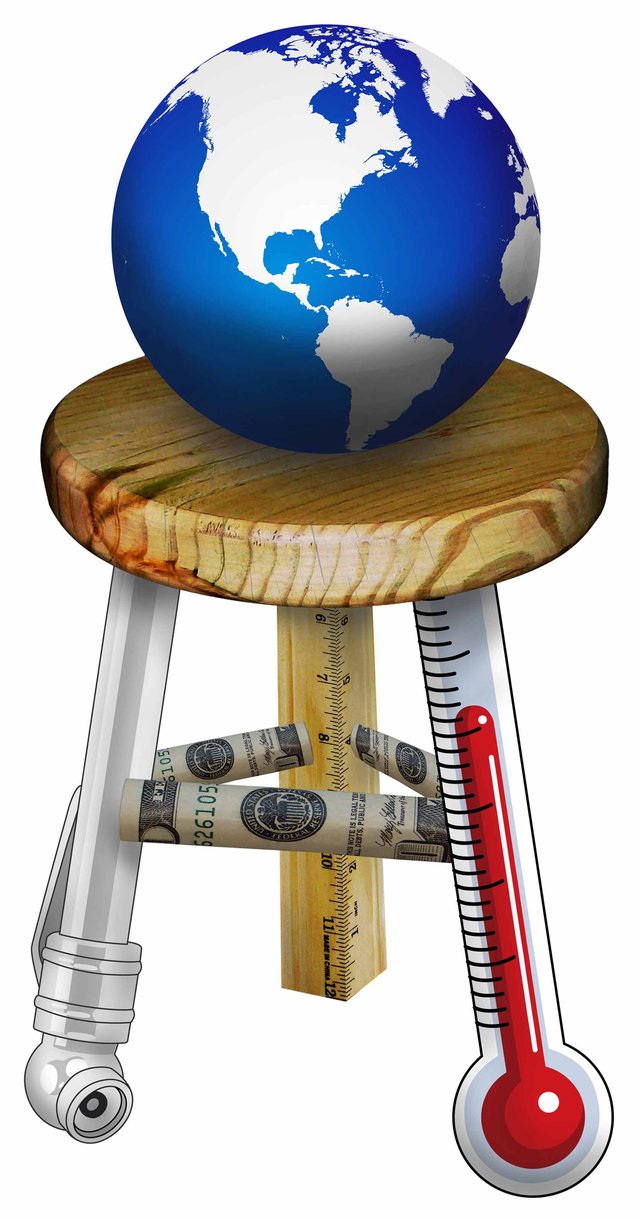
Policy on climate change rests on a three-legged stool of forecasts. First, it is necessary to have valid and reliable scientific forecasts of a strong, persistent trend in temperatures. Second, scientific forecasts need to show that the net effects of the trend in temperatures will be harmful. Third, scientific forecasts need to show that each proposed policy (e.g., a policy that polar bears require special protection because of global warming) would provide a net benefit relative to taking no action. A failure of any leg invalidates policy action.

Since 2007, we have searched for scientific forecasts that would support the three-legged stool of climate policy. We have been unable to find a single scientific forecast for any of the three legs — the stool currently has no support.

Two ways to encourage unity on the climate change issue would be to insist that forecasts be provided for all costs and benefits, and that all forecasting procedures abide by scientific principles. If validated principles are not included in the current forecasts, they should be added. Until we have scientific forecasts, there is no basis for unified action to prevent global warming — or cooling. Rational climate policies cannot rely on seers, no matter how many of them, how smart they are or how much expertise they possess.
J. Scott Armstrong is a professor at the University of Pennsylvania and author of “Long-Range Forecasting” (Wiley-Interscience, 1985).

Northern India shivers as incessant rain plunges the mercury again


(IndiaToday) Wet winter conditions gripped North-West India on Monday, with Delhi and several other plain areas receiving rains and hills snowfall.

Though clouds have put an end to the cold wave, the weather department has predicted a fall in temperatures by 4-6 degrees Celsius in the region and parts of Central India from February 7 onwards.

Intermittent rain lashed many parts of the Capital on Monday and more showers are expected in the next few days. Upper reaches of Himachal Pradesh and Jammu and Kashmir received heavy to very heavy snowfall.
"Overall, it is a good wet spell over North-West India. One-to-two spots in Himachal Pradesh have got around 100 cm of snowfall," said Dr. B. P. Yadav, director, India Meteorological Department.
Punjab, north Rajasthan and Haryana have received good amount of rainfall, he said, adding that Delhi - which recorded 1.6 mm rain between 9 am and 5.30 pm on Monday - is expected to witness more thunderstorms.

The weather department has forecast rains and thundershowers over Delhi, Punjab, Haryana, Uttar Pradesh and Rajasthan over the next three days. It has also warned of hailstorm in these states in addition to J&K, Himachal Pradesh and Uttarakhand during this period.
Heavy rains lash the capital

As per met office, rainfall recorded in the last 24 hours in February is the highest since 1942 in Delh; it is 46.0 mm; 1942 holds all time record of 104.1 mm.

Heavy rains lashed the national capital today, throwing traffic out of gear in many parts of the city due to waterlogging. The Met department has predicted more rains and thunderstorm in the capital throughout the day.

The rain gauges measured 1.8 mm of rainfall for a period of 24 hours till 8:00 AM. The rains, which started late last night, continued this morning.

Vehicular movement was affected in several areas, including ITO, Vikas Marg and South Extension due to low visibility and waterlogging.

Commuters at Andrew Ganj, Mahipalpur, Hari Nagar, IIT crossing to Adchini, Yusuf Sarai Market, Munirka flyover, Badarpur border, Wazirpur industrial area, Ashok Vihar, Laxmi Nagar, Mahipalpur and Lala Lajpat Rai Marg suffered due to waterlogging.

The minimum temperature was recorded at 11.7 degrees, three notches above normal but the windchill factor added to the chill in the air.

The maximum temperature in the last 24 hours was recorded at 19.3 degrees Celsius, which is three degrees below normal. The Met department said cloudy weather condition is likely to continue for the next couple of days.